Sailgene Technology

Nanopore Direct RNA Sequencing: Reading Native RNA at Single-Base Resolution
Release time:2026-11-09 16:07:18
Nanopore Direct RNA Sequencing: Reading Native RNA at Single-Base Resolution
Key Takeaways
- DRS sequences native RNA molecules end to end — no reverse transcription, no PCR — preserving modifications, isoform context, and poly(A) tails in a single read.
- It calls m6A, m⁵C and pseudouridine at single-base resolution and estimates modification stoichiometry from single molecules.
- A 2026 Nucleic Acids Research atlas across 21 mammals shows what peak-level methods miss: site-level conservation, purifying selection, and m6A–splicing coupling.
- Choose DRS when the question is "which base, on which isoform, at what level?" — especially in non-model organisms.
Most RNA sequencing workflows read a copy of the RNA, not the RNA itself. Reverse transcription and PCR amplification erase the native molecule's modifications, shorten its length, and collapse full-length isoforms into fragments. For questions about RNA modifications, poly(A) tails, or isoform-specific regulation, that is a measurement problem before it is a biological one.
Direct RNA Sequencing (DRS) takes a different route. It sequences native RNA molecules end to end, without reverse transcription or PCR. As each RNA strand passes through a protein nanopore, the ionic current signal reports both the sequence and the chemical modifications on the bases. The result is single-molecule, full-length, modification-aware RNA data.
This article explains what DRS measures, how it compares with short-read and cDNA-based strategies, and what kinds of biology it makes accessible—using a 2026 Nucleic Acids Research m6A atlas across 21 mammals as a concrete example, alongside applications in plants, microbes, and clinical research.
What DRS actually measures
In a DRS run, native poly(A) RNA is loaded directly onto a nanopore array. A motor protein feeds each RNA strand through the pore at a controlled rate, and the resulting ionic current trace is decoded into a nucleotide sequence. Because the RNA is never converted to cDNA or amplified, three layers of information are retained in the same read:
Sequence. The base identity along the full-length RNA molecule.
Modifications. m6A, m⁵C, pseudouridine, and other modifications perturb the current signal in a sequence-context-dependent way. Trained models interpret these signal features and call modifications at single-nucleotide resolution.
Poly(A) tail and isoform context. Full-length reads span entire transcripts, so poly(A) length and splice isoform can be assigned to the same molecule that carries a modification call.
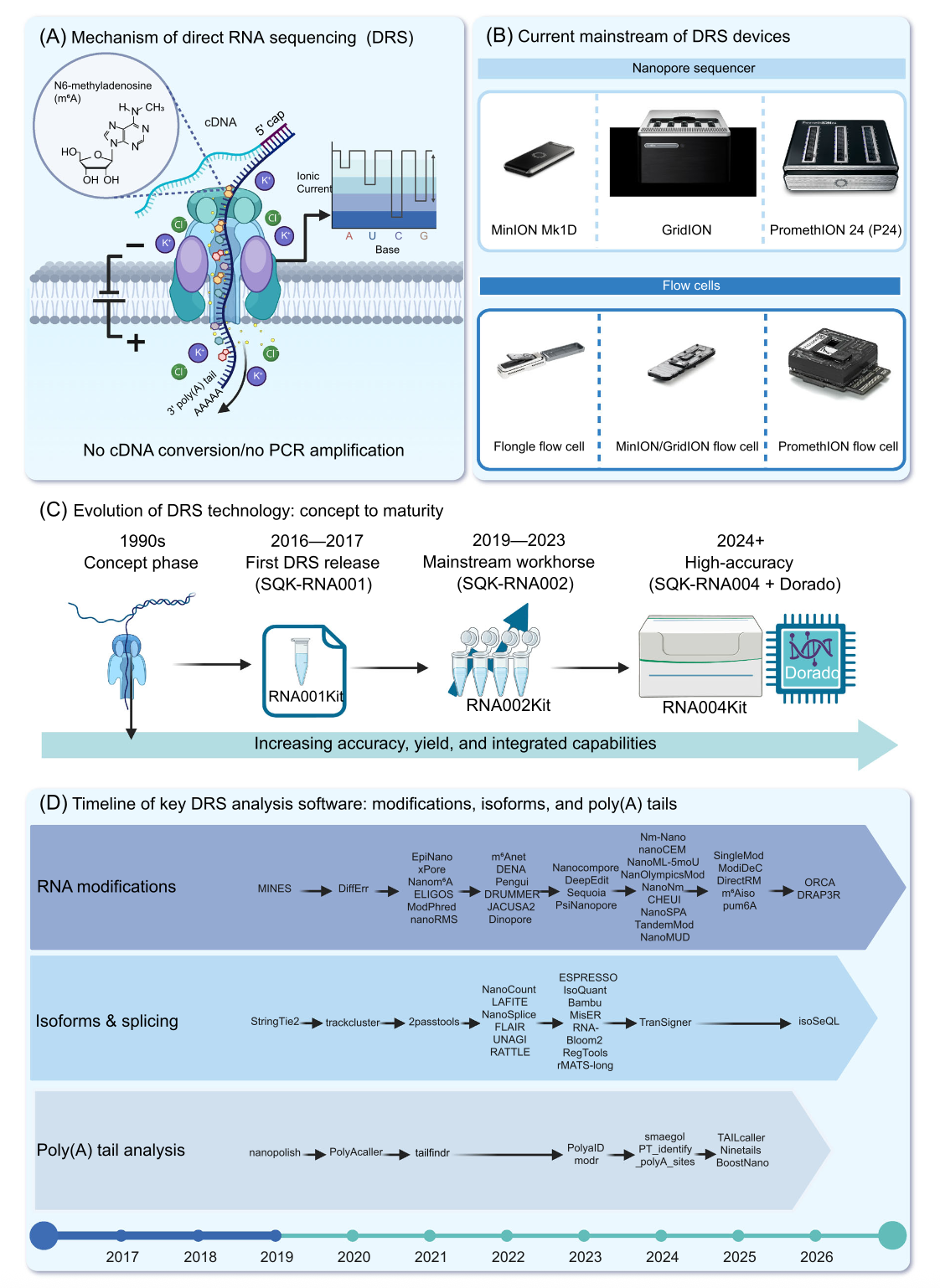
Figure 1 illustrates this workflow—from native RNA capture through nanopore signal decoding to the software ecosystem that interprets modifications, isoforms, and poly(A) tails. The trade-off is computational rather than chemical: DRS base-calling and modification-calling depend on robust models, and stringent thresholds are needed to control false positives. But unlike antibody-based enrichment, DRS does not depend on a species-specific reagent, and unlike short-read cDNA methods, it does not erase the native modification or collapse isoform context.
How DRS compares with other RNA sequencing strategies
Figure 2 summarizes the workflow differences between Illumina short-read RNA-seq, PacBio/ONT cDNA sequencing, and DRS. The key distinction is what each method preserves: short-read methods fragment RNA and lose native modifications; cDNA methods improve isoform resolution but still read a copy; antibody-based m6A methods enrich modified fragments but map them to 100–200 nt peaks rather than individual bases.
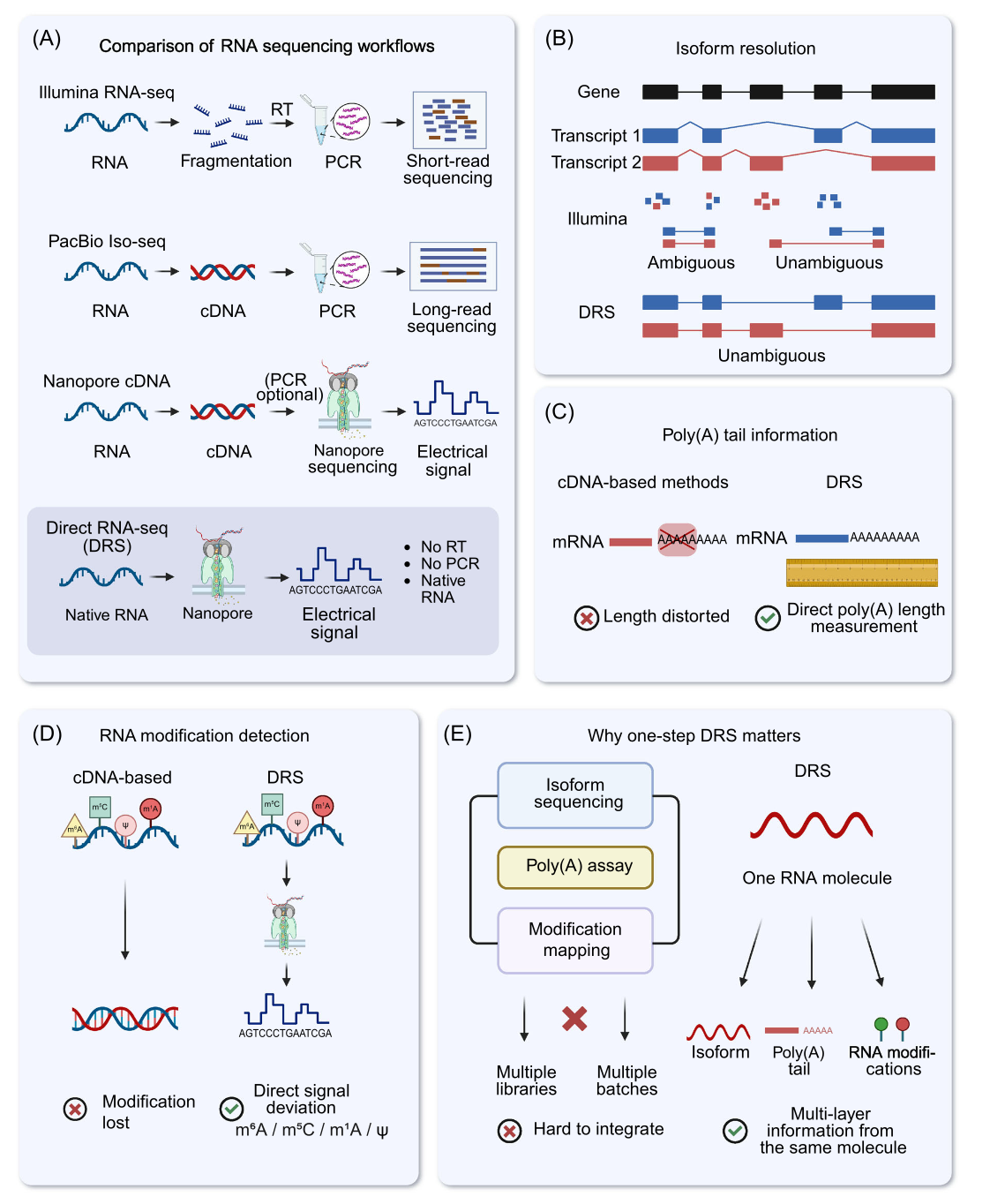
DRS sits in a different category: it reads the native RNA molecule, retains modification information, resolves full-length isoforms, and estimates modification stoichiometry from single-molecule reads. The practical comparison looks like this:
| Question | Short-read RNA-seq | Long-read cDNA | MeRIP-seq | Nanopore DRS |
|---|---|---|---|---|
| Full-length isoform resolution | Limited | Yes | No | Yes |
| Native RNA modification | Usually lost | Lost | Enriched, peak-level | Single-base, per read |
| Modification stoichiometry | No | No | Semi-quantitative | Read-level estimate |
| Antibody required | No | No | Yes | No |
| Poly(A) tail information | No | Limited | No | Yes |
No single method answers every question. But for studies where "which base, on which isoform, at what level?" is the central question, DRS is the only one of these strategies that measures all three directly.
What DRS makes possible across biology
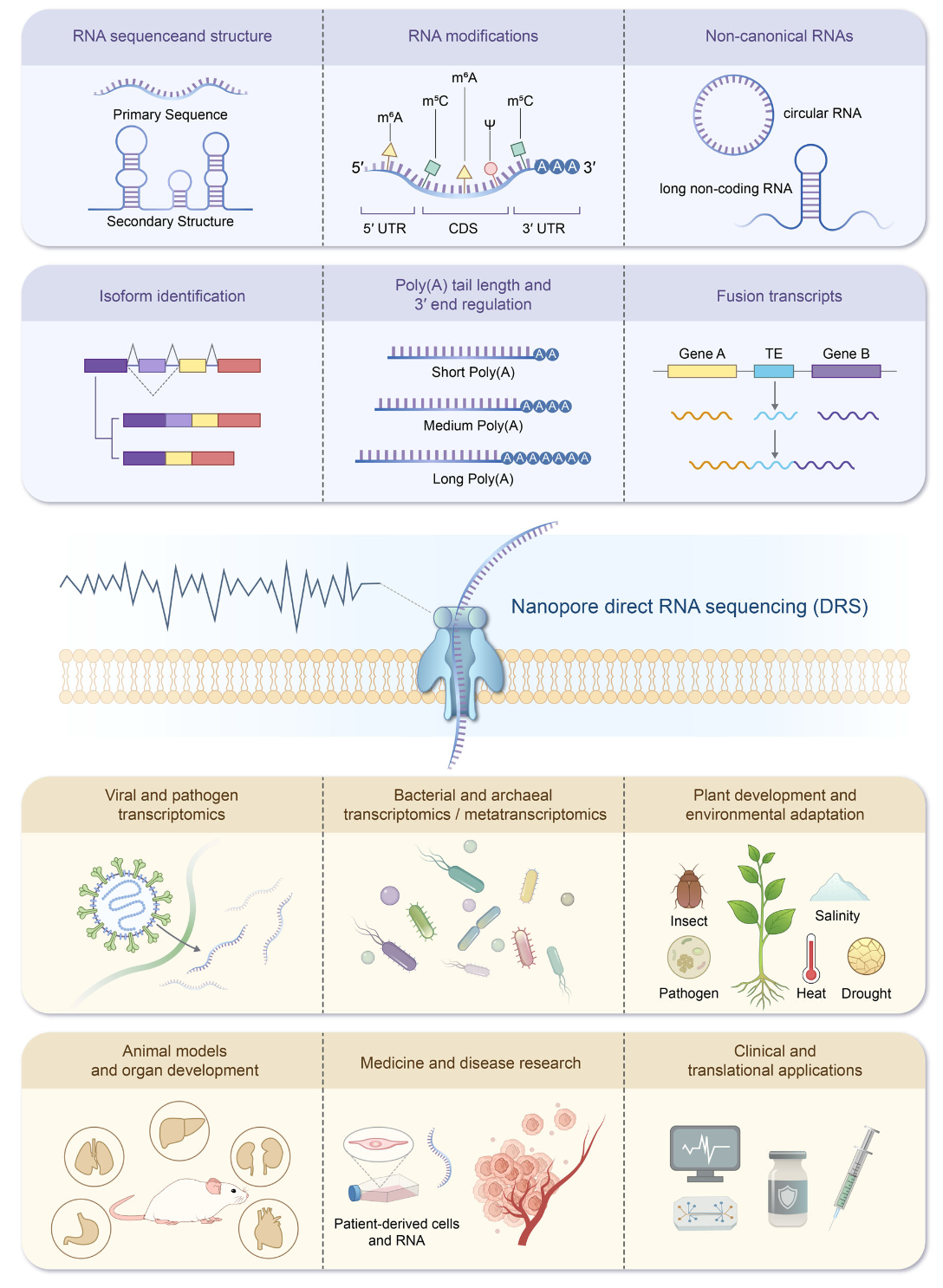
Because DRS reads native RNA, its applications extend beyond m6A. It has been used to map RNA modifications across transcriptomes, resolve isoform usage in development and disease, measure poly(A) tail dynamics, characterize non-coding and viral RNAs, and study non-model organisms where species-specific antibodies or annotations are limited. Figure 3 illustrates this breadth of applications, spanning viral, microbial, plant, animal, and clinical research. The common thread is that DRS preserves information other workflows discard.
One application deserves a closer look: cross-species m6A conservation. This is where the measurement problem is especially acute, because antibody-based peaks can hide the very sites you are trying to compare.
Case example: a single-base m6A atlas across 21 mammals
A 2026 Nucleic Acids Research study applied DRS to liver, kidney, and brain tissues from 21 non-model mammals spanning 11 orders—142 samples in total. The authors used the m6Anet framework with a stringent site-level probability threshold (>0.9) and a hybrid correction pipeline with short-read sequencing to achieve >99% sequence identity. They validated the calls against orthogonal methods: predicted modification probabilities correlated with GLORI-seq measurements in HEK293 cells across 3,219 shared loci (Pearson r = 0.67, P < 0.0001), and positional validation against MeRIP-seq data across corresponding species showed a median overlap of 85.57%.
The study illustrates four things DRS makes possible.
Single-base conservation analysis. Across orthologous transcripts, 25.54–35.70% carried m6A modifications, and m6A-modified sites showed significantly greater conservation than nearby unmodified regions, consistent with purifying selection. When a quantitative consistency constraint was added, the proportion of strictly conserved genes fell to roughly 15–24%. Positions can be conserved while modification levels shift—a distinction that peak-level analysis cannot resolve.
Selection signals at individual sites. m6A-modified positions showed stronger purifying selection than nearby unmodified adenines, even when controlling for codon position and restricting the analysis to 4-fold degenerate sites. This supports the view that many m6A sites are functionally constrained rather than incidental.
Modification–splicing coupling. Global m6A levels were significantly negatively correlated with alternative splicing entropy across tissues (PGLS: P = 0.03 in liver, P = 0.004 in kidney, P = 0.01 in brain). In cell experiments, 3-DAA treatment reduced m6A and significantly increased splicing complexity (P = 0.02, R = −0.72). Spatially, intron retention events—which lack exon junction complex binding—showed striking m6A enrichment near splice junctions (8,864 high-confidence sites), whereas EJC-dependent splicing events showed reduced m6A deposition in homologous regions. These observations are compatible with an EJC-associated spatial constraint model and are hypothesis-generating rather than causal.
Trait association with quantitative m6A levels. m6A levels in specific genes correlated with longevity (250 genes), adult body mass (164 genes), and basal metabolic rate (379 genes). Five genes—MLF1, CPLANE2, PMF1, RWDD4, and PLPL—were associated with all three traits. In long-lived mammals (n = 7, ≥26 years) compared with short-lived mammals (n = 14, <26 years), genes with higher m6A levels were more frequently under relaxed selection than intensified selection. These associations enable phylogenetically aware regression rather than peak-count heuristics, but they should be treated as hypothesis-generating.
The point of the example is not that every DRS project should be a 21-species atlas. It is that DRS changes the unit of analysis from peak to site, from gene to isoform, and from presence/absence to modification level. Those changes are what make cross-species m6A questions tractable.
When DRS is the right choice
- Cross-species or cross-tissue comparisons of RNA modifications
- Studies where modification level, not just site presence, matters
- Isoform-resolved modification analysis
- Non-model organisms where antibody performance is uncertain
- Projects linking RNA modifications to splicing, structure, or phenotype
Sailgene solution
Sailgene provides Nanopore Direct RNA Sequencing on native poly(A) RNA, without reverse transcription or PCR, preserving endogenous modifications and full-length isoforms. Our workflows include single-base modification calling with read-level stoichiometry, isoform-resolved analysis, and cross-species bioinformatics—ortholog mapping, motif and structure context, conservation scoring, splice-junction meta-profiles, and phylogenetically aware statistics. We also support study design and QC, including tissue selection, depth calculations, replicate strategy, and orthogonal validation options for targeted loci.
If your project requires native RNA information that short-read or cDNA workflows discard, DRS gives you the resolution those questions demand.
FAQ
What is Nanopore direct RNA sequencing?
DRS sequences native RNA molecules directly through a protein nanopore, without reverse transcription or PCR. The ionic current signal reports the RNA sequence and chemical modifications, and full-length reads preserve isoform and poly(A) context.
How does DRS detect m6A without antibodies?
m6A alters the ionic current signal in a sequence-context-dependent manner. Trained models such as m6Anet interpret these signal features and call m6A at single-nucleotide resolution. The 2026 atlas validated this approach against GLORI-seq and MeRIP-seq.
Can DRS quantify modification levels, not just identify sites?
Yes. Because each read derives from a single RNA molecule, the proportion of reads carrying a modification at a site provides a read-level estimate of modification fraction. This supports comparisons of modification levels across species and tissues.
Is DRS practical for non-model organisms?
Yes—this is one of its main advantages. DRS does not require species-matched antibodies, and full-length reads reduce dependence on perfect annotations. Ortholog mapping and quality control across references remain important, and Sailgene supports these steps.
Call to action
If you are planning a project that depends on native RNA modifications, isoform context, or non-model organisms, tell us your species, tissues, and target hypotheses. We will scope a DRS design—coverage, replicates, and analysis—around the biology you actually need to measure.
Reference
- Zhang T, Li J, Tang C, et al. Nanopore direct RNA sequencing and the epitranscriptome: Advances in mapping native RNA landscapes. iMeta. 2026;e70136. doi:10.1002/imt2.70136.
- Zhang X, Zhang Z, Liu W, et al. Single-base resolution atlas reveals moderate conservation and regulatory diversity of m6A modifications across mammals. Nucleic Acids Research. 2026;54(10):gkag544. doi:10.1093/nar/gkag544.
- Hendra, C., Pratanwanich, P.N., Wan, Y.K. et al. Detection of m6A from direct RNA sequencing using a multiple instance learning framework. Nat Methods 19, 1590–1598 (2022). https://doi.org/10.1038/s41592-022-01666-1.

Contact Us
If you are interested in our long-read sequencing services or potential collaboration, please contact us. Our team is ready to support your research with tailored solutions. We also welcome feedback from users to help us improve our services.

Contact Us
Add: One Innovation Drive, Suite B3-406, Worcester, MA 01605, USA
在线客服添加返回顶部
右侧在线客服样式 1,2,3 1
图片alt标题设置: SAILGENE TECHNOLOGY INC.
表单验证提示文本: Content cannot be empty!
循环体没有内容时: Sorry,no matching items were found.
CSS / JS 文件放置地