Sailgene Technology

Is Your MAG a Genome or Just a Mosaic? How ONT Long-Read Metagenomics Breaks the Assembly Ceiling
Release time:2026-11-23 14:16:52
- Short-read MAGs are statistical reconstructions: "high-quality" Illumina MAGs average 567 contigs, and only ~7% of >270,000 public MAGs retain any 16S rRNA sequence.
- ONT long reads span the repeats directly — mean contig N50 of 255.5 kb vs 7.8 kb, and 206 closed circular genomes recovered from a single soil metagenome.
- Closed genomes restore what short reads destroy: intact rRNA operons, plasmids, prophages, and BGC–host linkage for mobilome, resistome and drug-discovery research.
1. Introduction: The Genome That Was Never Cultured
Microorganisms are the dominant form of life on Earth, yet more than 90% of them cannot be cultivated under laboratory conditions. For decades, this "great plate count anomaly" kept the vast majority of microbial genetic resources invisible. Genome-resolved metagenomics offers a way around the culture bottle: DNA is extracted directly from an environmental community, sequenced, assembled, and computationally sorted into metagenome-assembled genomes (MAGs). Over the past decade, MAGs have become the workhorse of microbiome research — expanding the tree of life with thousands of candidate phyla, mining biosynthetic gene clusters (BGCs) for drug discovery, surveilling antimicrobial resistance genes (ARGs), and linking metabolic functions to specific taxa in soil, ocean, and gut ecosystems.
However, the field has quietly accepted a fundamental compromise: a MAG is not necessarily a genome. It is a statistical reconstruction assembled from hundreds of millions of tiny fragments. The widely used MIMAG standard defines a "high-quality" MAG as one with >90% completeness and <5% contamination — thresholds designed around what short-read data can deliver, not around what a real, closed microbial genome looks like. A typical "high-quality" short-read MAG is stitched together from hundreds of separate contigs and is silently missing precisely the features that define microbial biology: multi-copy rRNA operons, insertion sequences, plasmids, prophages, and long biosynthetic gene clusters.
The ceiling, in other words, is not sequencing depth but read length. Genome assembly is at its core a puzzle of repeats, and with 150 bp reads the repeats are walls that no algorithm can see across. Oxford Nanopore Technologies (ONT) long-read metagenomics changes the physics of the problem: when sequencing reads become longer than the repeats themselves, genome recovery stops being statistical inference and becomes direct observation.
2. Current Challenges: Four Structural Limits of Short-Read MAGs
While short-read shotgun sequencing has built the current MAG landscape, its inherent technical limits have now become the major bottleneck restricting the quality and biological interpretability of genome-resolved microbiome research:
Repeat-blind assembly: the fragmentation ceiling. Short-read assembly relies on de Bruijn graph algorithms that can only resolve repeats shorter than the read length. Bacterial and archaeal genomes are saturated with near-identical repeats far longer than 150 bp — rRNA operons of 4–7 kb present in up to 15 copies, insertion sequences, tRNA arrays, CRISPR cassettes, and integrated prophages. Every one of these loci breaks the assembly graph. The consequences are quantifiable: in a recent large-scale soil study, "high-quality" Illumina MAGs consisted of 567 ± 417 contigs with a mean N50 of only 11.8 kb; across the 5,640 soil-derived MAG entries in the GTDB database (spanning 91 projects), only two were single-contig assemblies longer than 1 Mbp.
Binning by inference, not by evidence. Because no single read physically links the assembled pieces, binning must assign contigs to genomes using k-mer composition and coverage similarity — statistical guesses rather than evidence. Strain microdiversity and conserved genomic regions routinely produce chimeric bins, collapsed strains, and cross-species contamination that remain invisible at the contig level. Plasmids and phages, whose copy number decouples from that of the host chromosome, are systematically excluded and left orphaned as "unbinned" fragments, severing the mobile fraction of the microbiome from its hosts.
The rRNA gap: MAGs that fail their own quality standard. The MIMAG definition of high quality requires an intact 5S–16S–23S rRNA operon and at least 18 tRNAs — yet the rRNA operon is the single most repeat-prone locus in prokaryotic genomes and is exactly where short-read assembly fails first. A survey of more than 270,000 publicly available MAGs found that only ~7% carry any 16S rRNA sequence, compared with 93% of complete reference genomes. The practical cost is severe: MAGs cannot be cross-linked to the enormous body of 16S amplicon data, so the two central data systems of microbiology — amplicon profiling and genome cataloging — remain disconnected.
Lost genomic context: function is architecture. Genes answer "what is present"; genomic architecture answers "how it works and with what it travels". BGCs routinely span tens to hundreds of kilobases and are cut to pieces in short-read assemblies; an ARG sitting next to a transposase on a plasmid carries a completely different transmission risk from the same gene on the chromosome; the boundary, integrase type, and induction behavior of a prophage cannot be resolved from 150 bp fragments. Short-read catalogs therefore report presence and absence, but not mobility, linkage, or synteny — the properties that determine ecological function and translational value.
Collectively, these limitations mean that adding sequencing depth cannot fix the problem: depth raises coverage of the same fragments, but it does not span a single repeat. The field needs reads that are longer than the structural features it wants to recover.
3. Technological Breakthroughs: Reading Through the Repeats
3.1 Technical Principle: From Fragment Inference to Molecule-Level Observation
ONT metagenomic sequencing relies on single-molecule nanopore sensing. High‑molecular‑weight DNA extracted directly from environmental microbial communities is sequenced without prior fragmentation and, optionally, without amplification. Optimized metagenomic workflows routinely produce read N50 values above 10 kb; the latest R10.4.1 chemistry delivers a modal raw‑read accuracy of ~99% (Q20+). One PromethION flow cell can generate tens of gigabases of data in a single run.
The fundamental logic is inverted. Short-read sequencing follows a "fragment first, infer later" mode that depends on algorithms to guess what connected the pieces; ONT long reads adopt "read through, then decide" — a single kb-level read walks through an entire rRNA operon and anchors itself in unique flanking sequence, so the ambiguity is resolved before assembly even begins.
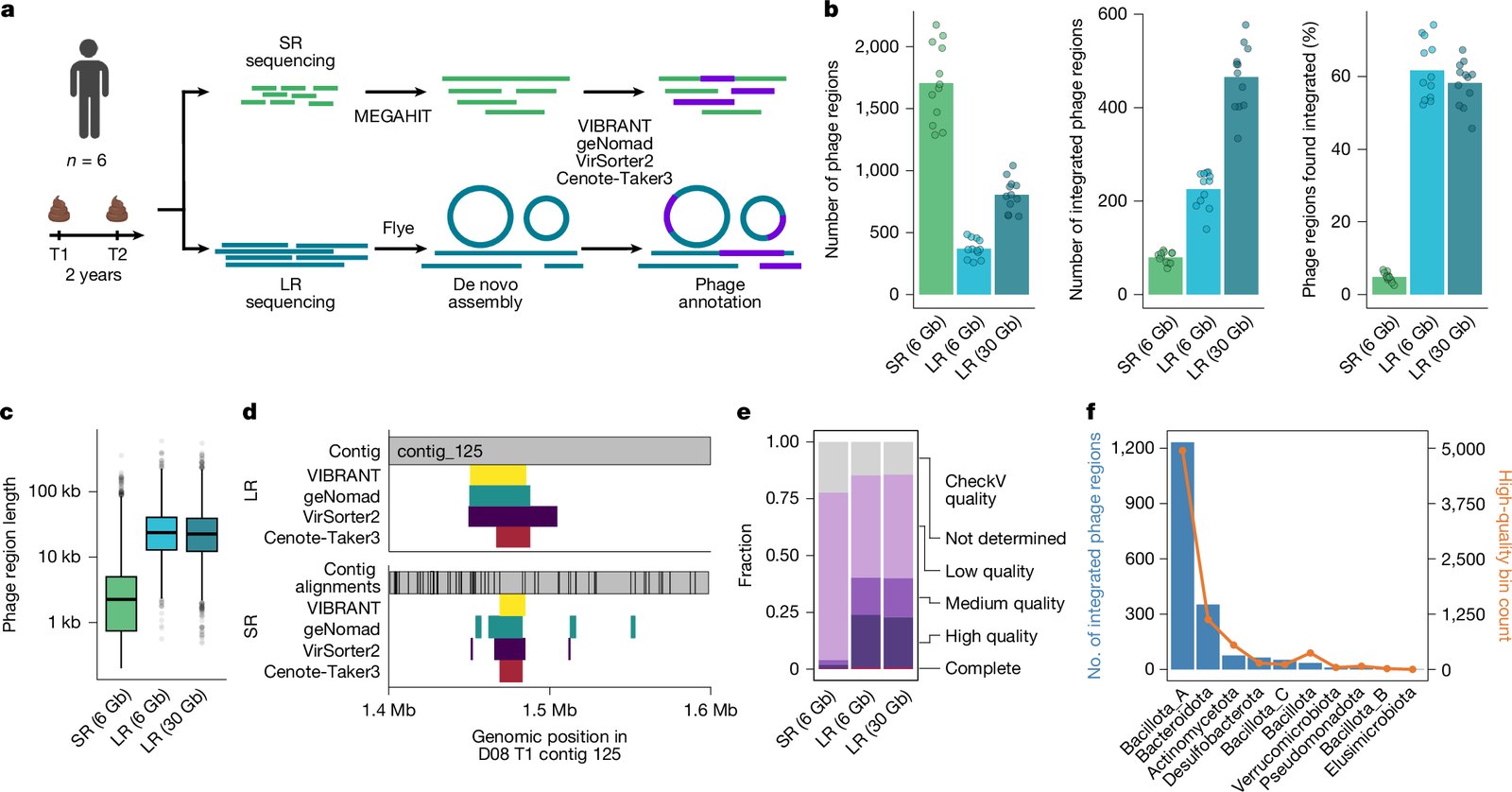
The effect on assembly contiguity is dramatic. In a two-year longitudinal gut cohort sequenced in parallel on both platforms, ONT long-read assemblies reached a mean contig N50 of 255.5 kb versus 7.8 kb for short-read assemblies of the same samples — a >30-fold gain that turns genome-scale neighborhoods, prophage integration sites, and mobile element context into directly resolvable features (Figure 1).
3.2 Core Technical Advantages: Solving the Four Pain Points of MAG Reconstruction
- Repeat-spanning assembly: reads longer than rRNA operons, insertion sequences, and phage integrations produce megabase-scale contigs and, for abundant taxa, single-contig circular genomes. Benchmarking on a complex anaerobic digester community showed that with R10.4 chemistry at ~40× coverage, short-read polishing is no longer needed: adding Illumina correction raised the number of high-quality MAGs from 34 to only 36, whereas the older R9.4.1 chemistry depended on it to climb from 64 to 86 (Nature Methods, 2022).
- Evidence-based binning: when contigs already carry genome-scale structure and intact marker-gene neighborhoods, binning becomes verification rather than guesswork, sharply reducing chimerism, strain collapse, and contamination-driven misassembly.
- The rRNA gap closed: intact 16S–23S–5S operons and complete tRNA arrays are recovered within single contigs, making MAGs formally MIMAG-compliant and directly cross-referenceable with amplicon-based studies.
- Architecture preserved: BGCs, ARG–mobile-element linkages, plasmids, and prophages are recovered on single contigs with their synteny intact, enabling mobilome and resistome analysis at true genome resolution.
Recent assembler development has closed the remaining accuracy gap. nanoMDBG (Nature Communications, 2026), designed for the latest ONT chemistry, reconstructed up to twice as many high-quality MAGs as metaFlye from a 400 Gbp soil dataset while consuming one third of the computing resources — and, critically, demonstrated that current ONT data can now deliver MAG construction results comparable to PacBio HiFi at the same sequencing depth.
3.3 Scientific and Application Value
The core innovation of ONT metagenomic sequencing is elevating microbiome research from "gene inventory" to "genome architecture", realizing three fundamental shifts:
1. From gene presence to genomic architecture. Complete genomic neighborhoods restore the biological meaning of genes. In a study published in Nature (2025), ONT long-read metagenomics tracked prophage dynamics in six healthy individuals over two years: long-read assemblies reached a mean contig N50 of 255.5 kb versus 7.8 kb for short reads, allowing researchers to resolve prophage integration sites, quantify dynamic gains and losses (~5% of phages), document cross-family host switching, and discover the novel "IScream phages" that co-opt bacterial IS30 transposases — phage–host relationships entirely invisible to short-read data.
2. From consensus bins to strain-resolved, closed genomes. Circular, near-finished genomes provide reference-grade anchors for uncultured taxa and make within-sample microdiversity, plasmids, and phage–host pairs resolvable at the strain level.
3. From catalogs to functions and molecules. Complete genomes connect biosynthetic gene clusters, resistance determinants, and mobile elements to their host organisms — the prerequisite for converting environmental DNA into concrete biotechnological and clinical leads.
3.4 Full Technical Workflow
ONT metagenomic research covers a closed-loop workflow from sample processing to biological interpretation, realizing standardized and high-precision genome-resolved analysis:
Sample collection & preservation → High-molecular-weight DNA extraction & QC → ONT library construction (ligation / ultra-long, PCR-free option) → PromethION platform sequencing → Basecalling & read QC → Metagenome assembly (metaFlye / metaMDBG) → Binning & refinement → MAG quality control (CheckM2, GTDB-Tk, circularization assessment) → Biological interpretation (novel species, BGC mining, ARG–MGE linkage, plasmid & prophage cataloging, strain-resolved ecology)
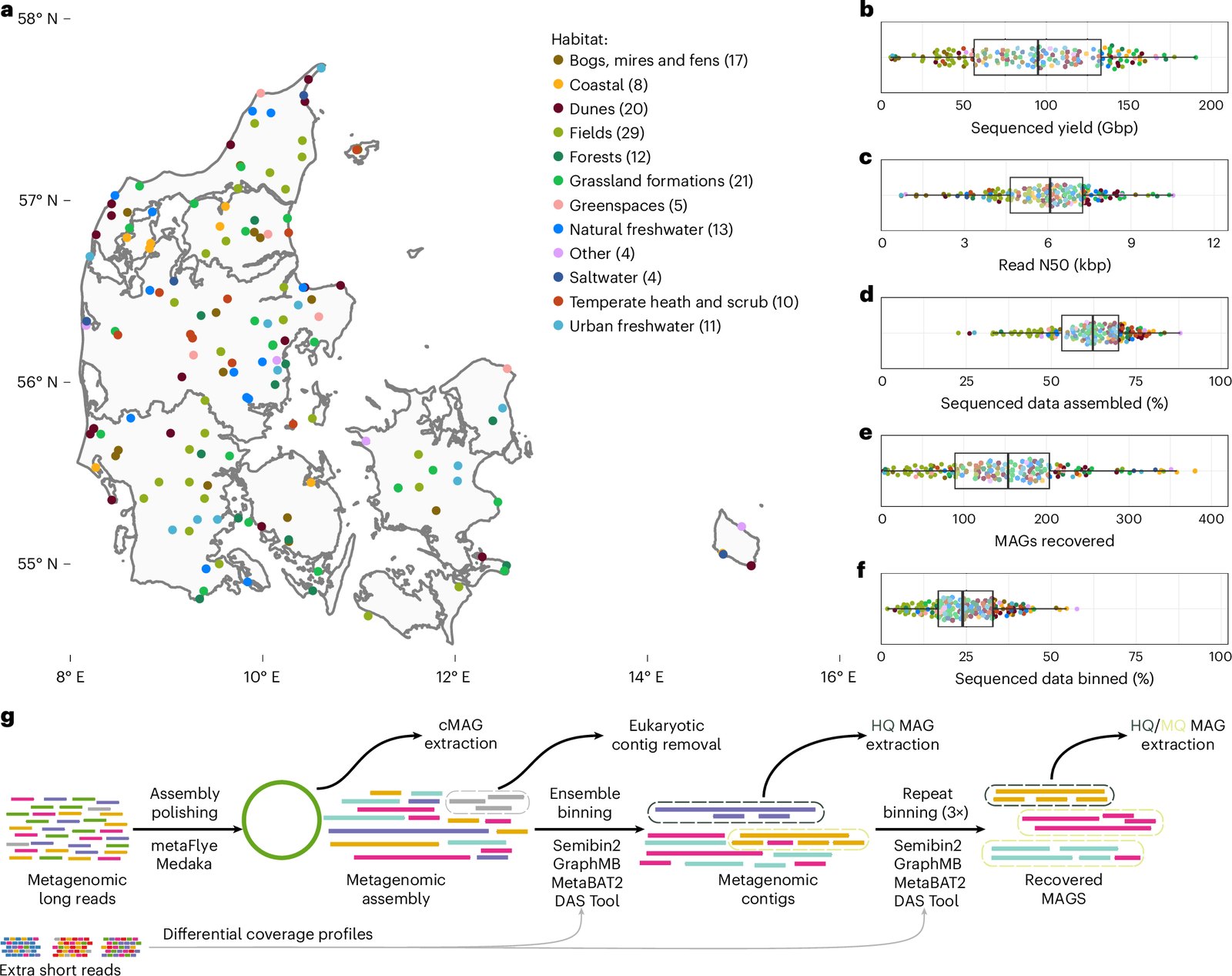
The workflow has been validated at population scale: deep Nanopore sequencing of 154 soil and sediment samples (14.4 Tbp in total) combined with a dedicated long-read binning workflow recovered the genomes of 15,314 previously undescribed microbial species spanning 1,086 uncharacterized genera, expanding the phylogenetic diversity of the prokaryotic tree of life by 8%, while retrieving thousands of complete rRNA operons, biosynthetic gene clusters, and CRISPR–Cas systems (Figure 2).
4. Research Case: 206 Closed Genomes from a Single Soil Metagenome
Paper Title: Bioactive molecules unearthed by terabase-scale long-read sequencing of a soil metagenome
Journal: Nature Biotechnology (IF 44.5)
Publication Date: September, 2025
DOI: 10.1038/s41587-025-02810-w
Soil hosts the densest microbial diversity on Earth and is simultaneously the most difficult matrix for metagenomics: high-molecular-weight DNA is hard to extract, and its biosynthetic gene clusters are long, modular, and highly mobile — exactly the features that short reads destroy. Even with more than 3 Tbp of short-read data, soil metagenome assemblies reach a contig N50 of only ~1.6 kb.
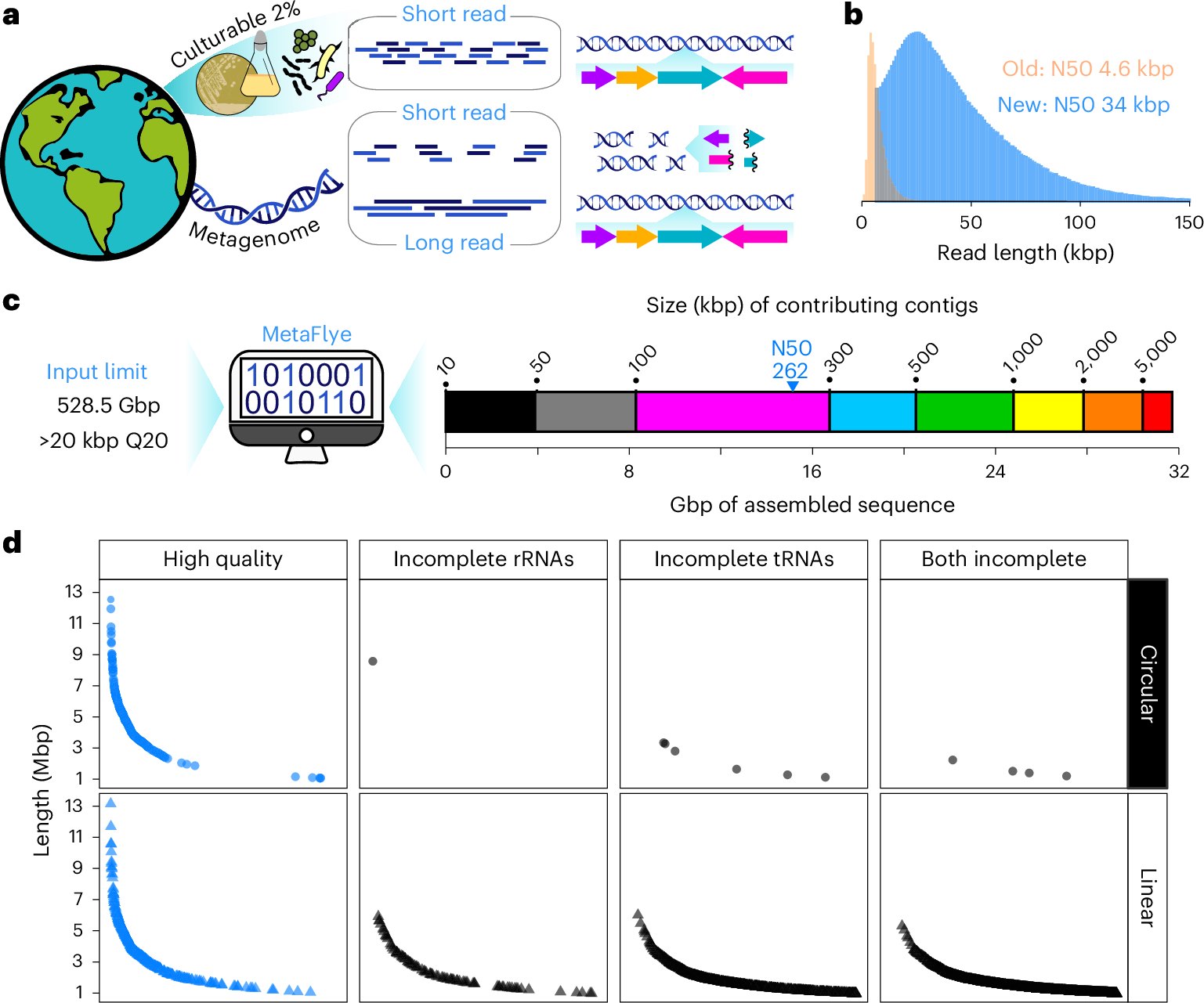
In this landmark study, researchers optimized the recovery of large DNA fragments from soil bacteria and paired them with nanopore long-read sequencing at terabase scale: 2.5 Tbp of ONT data in total from a single forest soil sample, with a single optimized run producing nearly 1 Tbp at a read N50 of 32.82 kb — two hundred times longer than the 150 bp industry standard. Assembling the 528.5 Gbp subset of reads longer than 20 kb (Q20+) with metaFlye produced a 32 Gbp assembly with a contig N50 of 262 kb.
The scale of genome recovery is unprecedented (Figure 3). More than 3,200 contigs exceeded 1 Mbp — two orders of magnitude more than the 26 soil MAG bins above that size found across all 5,640 entries in GTDB. Within these, 563 were single-contig assemblies containing a complete 5S–16S–23S rRNA operon and at least 18 tRNAs, and 206 of them were closed circular genomes with an average size of 4.95 Mb; 79% met near-complete MAG criteria (>90% completeness, <5% contamination), and only 2.7% exceeded the contamination threshold — all achieved without conventional binning. More than 4,500 species were detected in the dataset, spanning 16 phyla among the complete genomes, yet only 0.7% matched a known species. The study delivered the first complete genome of the enigmatic UBP17 phylum: a 12.56-Mbp circular assembly for a lineage previously represented by only ten highly fragmented MAGs.
The biological payoff was direct. Targeted assembly of non-ribosomal peptide synthetase (NRPS) reads retrieved 6.17 million A-domain-bearing reads into 118,000 contigs (N50 111 kb), yielding 366 NRPS BGCs of which 360 were entirely novel. From 20 predicted clusters, the team chemically synthesized 55 molecules, five of which showed significant antibacterial activity — including erutacidin, a broad-spectrum membrane antibiotic that binds cardiolipin, shows no cytotoxicity, and for which no resistance mutants could be obtained, and trigintamicin, a narrow-spectrum anti-Staphylococcus aureus molecule (MIC 2 µg/mL) whose ClpX target was revealed through the assembled genomic context.
Core Value of ONT Technology in This Research
Every headline result of this study is structurally impossible with short-read sequencing. Fragmented assemblies cut BGCs mid-cluster and scatter the pieces across unbinned contigs; missing rRNA operons leave recovered genomes anonymous; and without single-contig assemblies there is no way to state "this molecule comes from this cluster in this organism". ONT long reads supplied the megabase-scale contiguity that converted a gene catalog into a discovery platform — from 567-piece mosaics to 206 closed circles, and from anonymous dark matter to new antibiotic scaffolds. The study resets the benchmark for what a metagenomic project can deliver and demonstrates the complete path from closed MAGs to functional molecules.
5. Sailgene Professional ONT Metagenomic Solutions
Sailgene is a professional biotechnology company focusing on long-read sequencing, NGS sequencing, and integrated bioinformatics solutions. We provide comprehensive multi-omics services covering genomics, transcriptomics, microbiomics, and epigenomics, serving scientific research and industrial applications in biomedicine, agriculture, animal husbandry, and environmental science.
In the field of ONT metagenomic sequencing, Sailgene has accumulated rich project experience across complex sample types including soil, sediment, feces, rumen, sludge, and biofilm, with optimized protocols for the high-molecular-weight DNA extraction that determines long-read success. Our one-stop ONT metagenomic services include:
- 1. Full-process technical support: Customized experimental design, professional sample processing, matrix-optimized HMW DNA extraction, diverse library construction modes, and high-throughput sequencing based on the ONT PromethION platform, delivering standardized and high-quality raw data.
- 2. Professional in-depth bioinformatic analysis: Covering long-read metagenome assembly, ensemble and multi-sample binning, MAG quality control, plasmid and prophage identification, ARG–MGE linkage mining, and strain-resolved community analysis.
- 3. Multi-omics integrated analysis: Combining metagenomics with full-length 16S amplicon, metabolomic, and other omic data to link "who is there, what they carry, and what they do" within a single analytical framework.
- 4. Customized solution development: Tailoring sequencing depth and analysis schemes to different ecosystems and research objectives — from routine community profiling to large-scale microbial dark matter exploration.
With rigorous quality control standards and professional technical capabilities, Sailgene helps researchers break through the assembly ceiling of short-read MAGs and recover complete, circular, and biologically interpretable genomes from any environment.
6. FAQ: Common Technical Questions & Answers
Q1: Which samples benefit the most from ONT long-read metagenomics, and which are not recommended?
Ideal candidates include high-diversity samples such as soil, sediment and rumen, which are rich in repetitive elements, prophages and BGCs. This approach is well suited for recovering circular genomes, full rRNA operons, and linkage information between plasmids and prophages. It is less suitable for samples with severely degraded DNA, low biomass, or projects prioritizing high-precision SNP and strain-level variant calling.
Q2: What is the recommended data volume for ONT metagenomic sequencing?
It depends on community complexity and research objectives: for low-complexity communities (gut, sludge, enrichment cultures), 10–20 Gbp per sample is generally sufficient; for highly diverse environments such as soil, sediment, and rhizosphere, 30–50 Gbp is recommended; for microbial dark matter exploration or BGC mining, 100 Gbp or more is advised. As a rule of thumb, circularizing a dominant taxon requires roughly 30× coverage of its genome, so data volume should be planned against the abundance of the target organisms. In all cases, the decisive upstream factor is high-molecular-weight DNA quality — no amount of depth compensates for sheared input DNA.
Reference
- Wirbel, J., Hickey, A. S., Chang, D., et al. Long-read metagenomics reveals phage dynamics in the human gut microbiome. Nature, 2025. doi:10.1038/s41586-025-09786-2
- Sereika, M., Mussig, A. J., Jiang, C., et al. Genome-resolved long-read sequencing expands known microbial diversity across terrestrial habitats. Nature Microbiology, 2025. doi:10.1038/s41564-025-02062-z
- Burian, J., Boer, R. E., Hernandez, Y., et al. Bioactive molecules unearthed by terabase-scale long-read sequencing of a soil metagenome. Nature Biotechnology, 2025. doi:10.1038/s41587-025-02810-w
- nanoMDBG: long-read metagenomic assembler for the latest ONT chemistry. Nature Communications, 2026.
Previous Page
Previous Page

Contact Us
If you are interested in our long-read sequencing services or potential collaboration, please contact us. Our team is ready to support your research with tailored solutions. We also welcome feedback from users to help us improve our services.

Contact Us
Add: One Innovation Drive, Suite B3-406, Worcester, MA 01605, USA
在线客服添加返回顶部
右侧在线客服样式 1,2,3 1
图片alt标题设置: SAILGENE TECHNOLOGY INC.
表单验证提示文本: Content cannot be empty!
循环体没有内容时: Sorry,no matching items were found.
CSS / JS 文件放置地