Sailgene Technology

Nanopore Ultra-Long Reads and Adaptive Sampling Complete Plant T2T Genomes
2026
Nanopore Ultra-long Sequencing (PromethION platform)
Plants
Case Study
Research Background
Telomere-to-telomere (T2T) genome assembly is the new gold standard in plant genomics, but plant genomes are among the hardest to finish: polyploidy, massive repeat content, and long centromeric and telomeric arrays keep most published assemblies short of "complete."
Short NGS reads (2 × 150 bp) cannot traverse these repeats, and even routine long reads fall short. The authors surveyed crop T2T projects from 2022–2023 and found that the average N50 of ONT input reads was just 50.78 kb — and that "near-complete" plant assemblies typically still carry about ten unresolved gaps.
A team at the Peking University Institute of Advanced Agricultural Sciences asked whether two ONT-native capabilities — ultra-long read sequencing and real-time adaptive sampling (AS) — could close that gap, and delivered a complete, reproducible workflow for plant T2T assembly.
Experimental Design & Technical Strategy
The study rebuilt the plant long-read workflow from the ground up:
- DNA extraction: a nuclei-preserving, four-stage protocol that yields DNA fragments exceeding 485 kb, using young tissues (dark-grown coleoptiles for monocots; young leaves or buds for dicots) and gentle, wide-bore handling throughout.
- Library preparation: an improved transposase-based method (Tn-L) that needs only 3–5 µg input DNA (versus 30–40 µg in the standard protocol) and adds Long Fragment Buffer washes to strip short fragments; a gradient-transposase variant (Tn-L+) pushed read N50 to 440 kb.
- Sequencing: ONT PromethION flow cells across more than a dozen plant species.
- Adaptive sampling: MinKNOW ejects non-target strands in real time, guided by BED files with 100–150 kb "buffer" regions flanking known gaps or telomeres.
The logic is simple: extract ultra-long DNA, sequence deeply enough to assemble, then aim the remaining sequencing capacity directly at whatever gaps survive — no second DNA sample required.
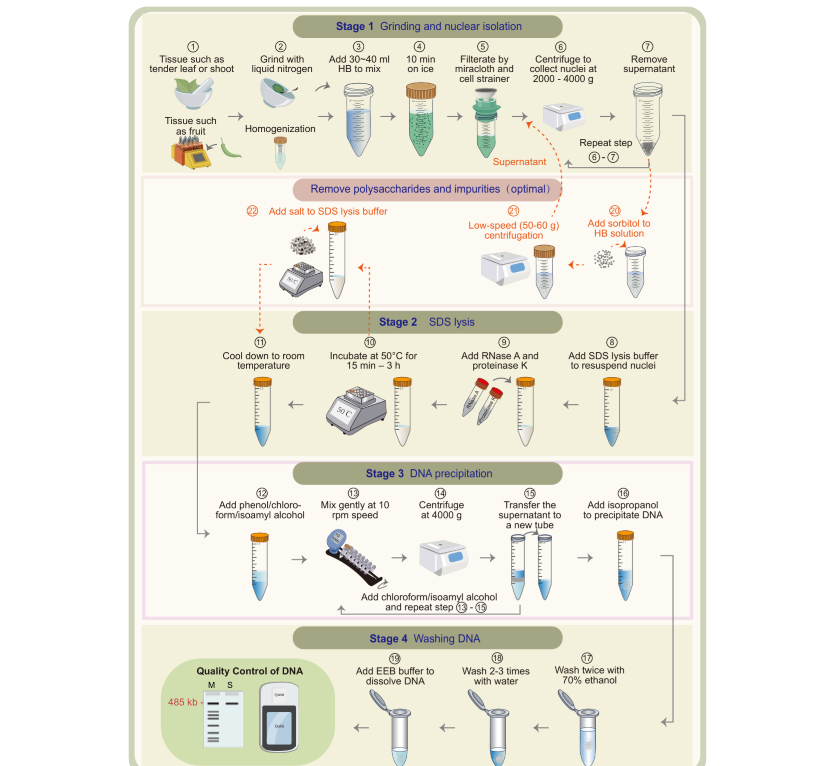
Figure 1, Lu et al., 2024. The optimized plant DNA extraction workflow preserves ultra-high-molecular-weight DNA (up to 485 kb shown by pulsed-field gel) from intact nuclei through SDS lysis, precipitation, and washing.
Key Results
1. Read lengths well beyond the field average
Across species, the optimized protocol delivered an average read N50 of 80.57 kb and a maximum N50 of 440 kb — versus a field average of 50.78 kb and a maximum raw-read N50 of only 73 kb in recent plant T2T studies. Ultra-long reads (>100 kb) made up 70–91% of raw output, and the longest single read reached 5.83 Mb.
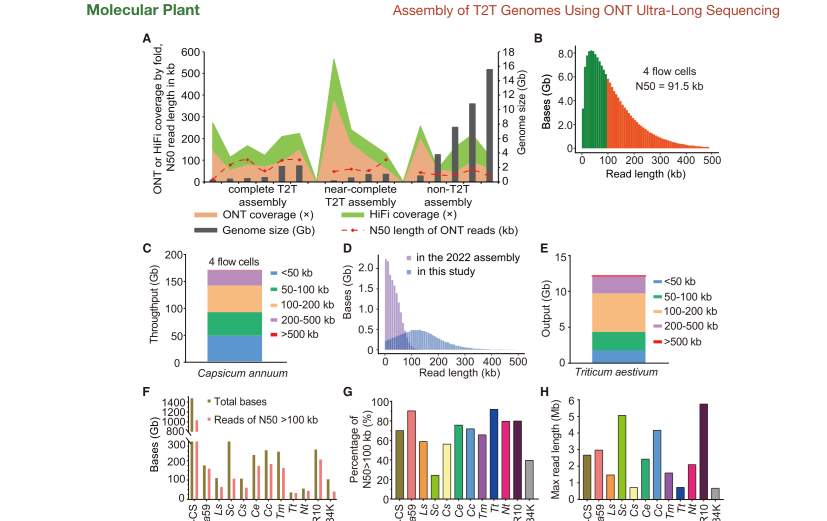
Figure 2, Lu et al., 2024. ONT versus HiFi coverage and read N50 across 2022–2023 crop T2T assemblies (A), and read-length distributions for chili pepper (B–C) and wheat (D–E) produced by the optimized workflow.
2. Complete T2T genomes at dramatically lower cost
The workflow produced complete T2T assemblies across genome sizes: watermelon (~380 Mb) from a single PromethION flow cell at 57.1× coverage; chili pepper (~3.1 Gb) — the longest complete plant T2T genome published at the time — from four flow cells yielding over 180 Gb with an average N50 of 91.5 kb; and hexaploid wheat (~15 Gb), for which 283 flow cells generated 1.8 Tb of reads exceeding 100 kb. Most strikingly, sorghum (717 Mb) was assembled to complete T2T using ONT ultra-long reads alone, with no HiFi or Illumina support. At roughly $25 per gigabase, the authors estimate a complete T2T genome for species under 1 Gb for less than $2,500.
3. Adaptive sampling fills the last gaps
On the near-complete Arabidopsis Col-PEK genome, AS enriched gap-spanning reads even though standard sequencing generated more than double the total output: per-base coverage in target regions reached 5,113× versus 3× in non-target regions. All six gaps were closed, extending the genome by 79,980 bp — including a distal telomeric gap resolved by reads carrying CCCTAAA repeats. In wild watermelon (Citrullus ecirrhosus), two AS flow cells (8.3 Gb) filled a 41,262-bp telomeric gap on chromosome 8, completing that T2T assembly.
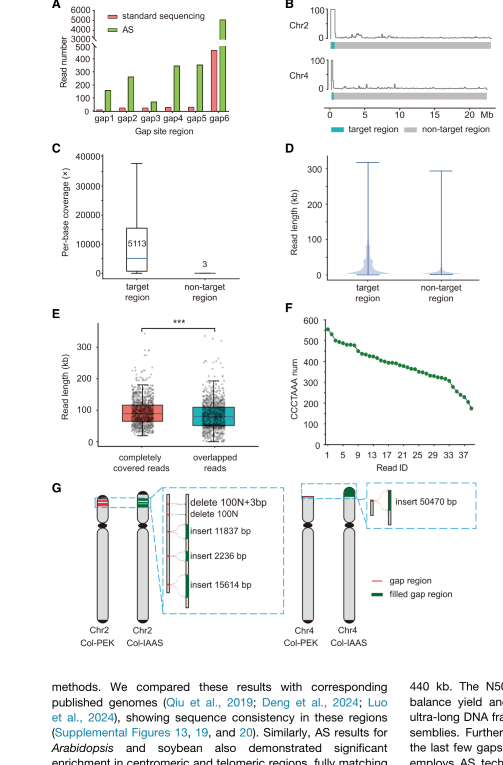
Figure 3, Lu et al., 2024. Adaptive sampling on the Arabidopsis Col-PEK assembly: AS enriched gap-spanning reads (A), raised per-base coverage to 5,113× versus 3× (C), and closed all six gaps (G).
Scientific Significance
This resource article turns plant T2T assembly from a bespoke effort into a practical pipeline. The message for anyone planning a plant genome project is quantitative: aim for at least 50× ONT coverage, prefer read N50 above 100 kb for large diploid genomes, and budget one PromethION flow cell per small-genome accession.
The adaptive sampling results are arguably the more novel contribution. AS has mostly been used to enrich known reference sequences; here it was pointed at unknown sequence — unresolved gaps and unsequenced telomeres — and recovered it from the same library in real time. Gap-filling stops being a separate resequencing project and becomes a final, targeted sequencing round.
The authors are candid about limits: current R10 chemistry averages around Q20, still short of HiFi-grade Q30, and AS loses efficiency in polyploid genomes when targets have many copies. Even so, the combination of ultra-long reads and on-instrument enrichment now makes complete, gapless plant genomes an affordable default rather than an exception.
Related Sailgene Services
Sailgene provides Nanopore Ultra-long Sequencing on the PromethION platform (read N50 > 150 kb) for resolving long repeats and complex regions, end-to-end Telomere-to-Telomere (T2T) Genome and Haplotype-resolved T2T Genome assembly services, and Pan Genome solutions for multi-accession plant pangenome projects — the same technology stack this study relied on.
Reference: Lu, D. et al. "Nanopore ultra-long sequencing and adaptive sampling spur plant complete telomere-to-telomere genome assembly." Molecular Plant 17, 1773–1786 (2024).
Contact Us
If you are interested in our long-read sequencing services or potential collaboration, please contact us. Our team is ready to support your research with tailored solutions. We also welcome feedback from users to help us improve our services.

Contact Us
Add: One Innovation Drive, Suite B3-406, Worcester, MA 01605, USA
在线客服添加返回顶部
右侧在线客服样式 1,2,3 1
图片alt标题设置: SAILGENE TECHNOLOGY INC.
表单验证提示文本: Content cannot be empty!
循环体没有内容时: Sorry,no matching items were found.
CSS / JS 文件放置地