Sailgene Technology

Nanopore direct RNA sequencing and theepitranscriptome: Advances in mapping native RNAlandscapes
2026
Direct RNA Sequencing
human
Case Study
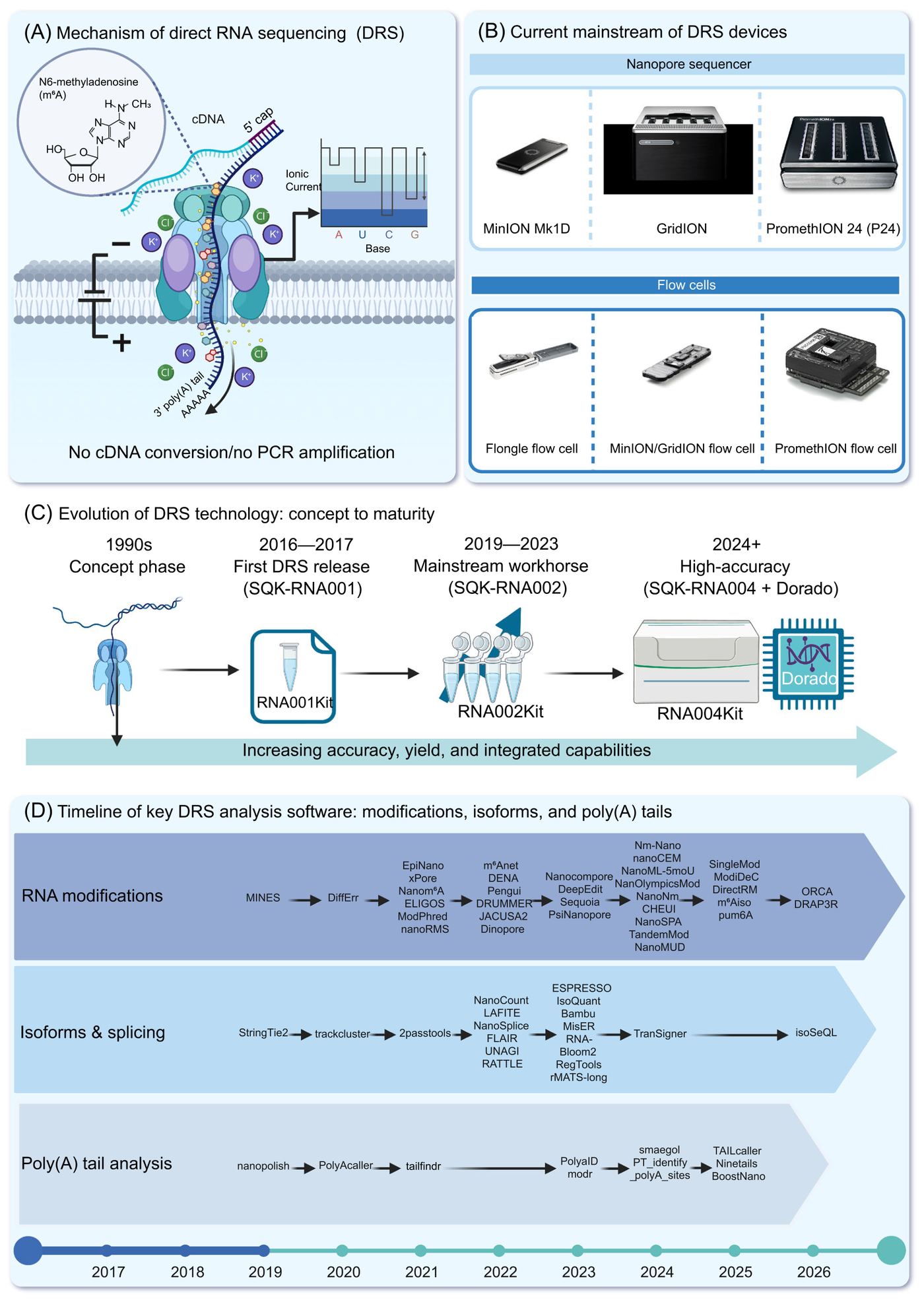
- Nanopore direct RNA sequencing reads native RNA without reverse transcription or PCR, capturing sequence, splice structure, poly(A) tail length and chemical modifications on the same molecule.
- SQK-RNA004 with Dorado basecalling raised median read identity to 98.67% (from 90.65% on RNA002 with Guppy), lifted throughput about 2.5-fold, and calls up to eight modification types per run.
- Input is now the limit: about 300 ng of poly(A) RNA or 1 µg of total RNA, poor recovery below 100–150 nt, and no single-cell DRS yet.
Research Background
More than 90% of multi-exon human genes and roughly 80% of plant genes are alternatively spliced, 3′ ends are chosen from several polyadenylation sites, and m6A, m5C, pseudouridine and inosine mark only some transcripts. Short reads see fragments; cDNA long reads keep length but erase the marks.
Direct RNA sequencing skips the copy step. Native poly(A)+ RNA is driven through a protein nanopore, about five nucleotides sit in the pore at a time, and the current trace is decoded into bases — and, in the same pass, into modification calls and tail length. Nothing is converted, so nothing is lost. What held the method back was 90–94% single-read accuracy.
Scope & Analytical Framework
Zhang and colleagues review a decade of DRS work in iMeta. Their organizing device is a confidence ladder: what the signal shows directly, what a model infers, and which biological claims each can carry.
- Signal: raw current basecalled with Dorado or Guppy, with error profiles compared rather than a single accuracy headline.
- Molecule: full-length splice structure, alternative start sites, alternative polyadenylation and tail length from one read, with tail tools benchmarked on synthetic standards.
- Modification: m6A, m5C, pseudouridine, inosine and 2′-O-methylation mapped onto specific isoforms rather than collapsed to gene level.
- Validation: in vitro-transcribed negative controls, MeRIP-seq and LC-MS/MS as orthogonal checks, with a stated confidence level for each call.
Key Results
1. Single-read identity now reaches 98.67%
SQK-RNA004, built on redesigned pores and motor proteins, lifted accuracy to about 98% (F1 96–99%) from 90–94% on RNA002. Head to head, RNA004 reads basecalled with Dorado reached a median alignment identity of 98.67%, against 90.65% for RNA002 with Guppy; ONT's own benchmarking adds a 2.5-fold throughput gain and a median accuracy move from about 93% to 98.7%. Dorado 1.0 and later call up to eight modification types in a single run.
2. Four layers now resolve on one molecule
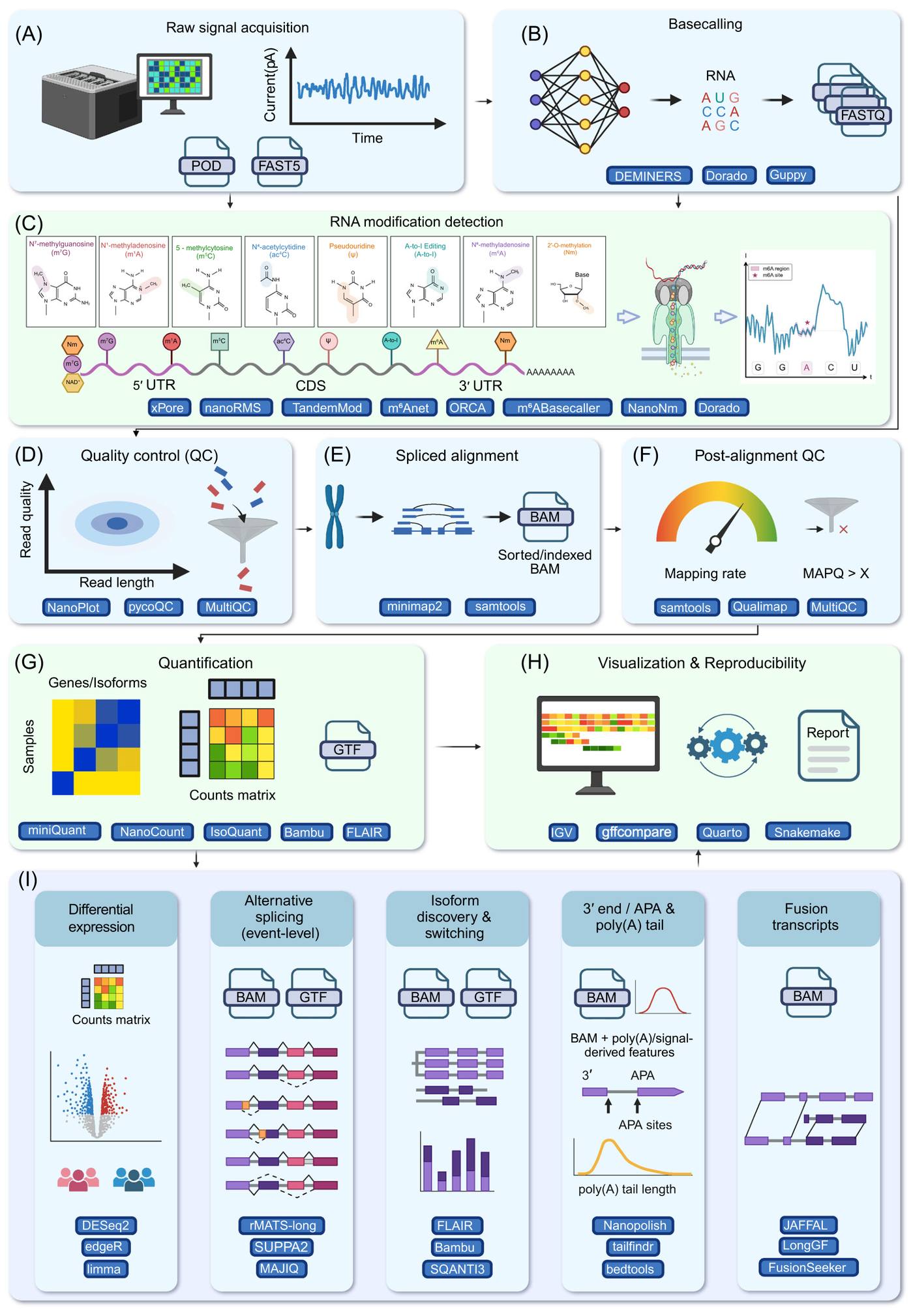
The payoff is vertical: fewer reads, each carrying more. One pass links splice structure, 3′ end choice, tail length and modification state — the combination short reads must reconstruct statistically. Poly(A) callers (nanopolish, tailfindr, Dorado, BoostNano) recover mean tail lengths within about 12% of truth on Sequins standards. In Populus trichocarpa xylem, nanopore m6A inference found 3,253 modified genes, 2,626 overlapping MeRIP-seq, while keeping transcript-level resolution; in leukemia cells, joint m6A, tail, abundance and splicing profiling tracked transcript-specific shifts after writer perturbation.
3. The clearest wins are viral, microbial and plant
Where molecules are scarce and isoforms matter, DRS pays off. Adenoviral m6A controls splicing efficiency of late transcripts; SARS-CoV-2 m6A clusters at the 3′ end; HBV mRNAs carry four high-confidence m5C sites. In Klebsiella pneumoniae, native reads detected expression of at least 35% of plasmid-borne resistance genes within about 10 hours and resolved co-transcribed operons such as rmtB–blaTEM-1.
4. Input, short RNAs and single cells remain out of reach
The costs are explicit. SQK-RNA004 needs about 300 ng of poly(A) RNA or 1 µg of total RNA, which excludes plasma, extracellular vesicle and biopsy samples. Molecules under roughly 100–150 nt are poorly captured, leaving 22–45 nt cell-free RNAs — the liquid-biopsy markers — largely invisible; poly(A) selection also misses non-polyadenylated lncRNA and circRNA, which need rRNA depletion or dedicated chemistry. Single-cell DRS, the authors state, has not been developed, so isoform-level single-cell work still runs on long-read single-cell cDNA; throughput and residual systematic error keep DRS behind short reads for routine quantification.
Scientific Significance
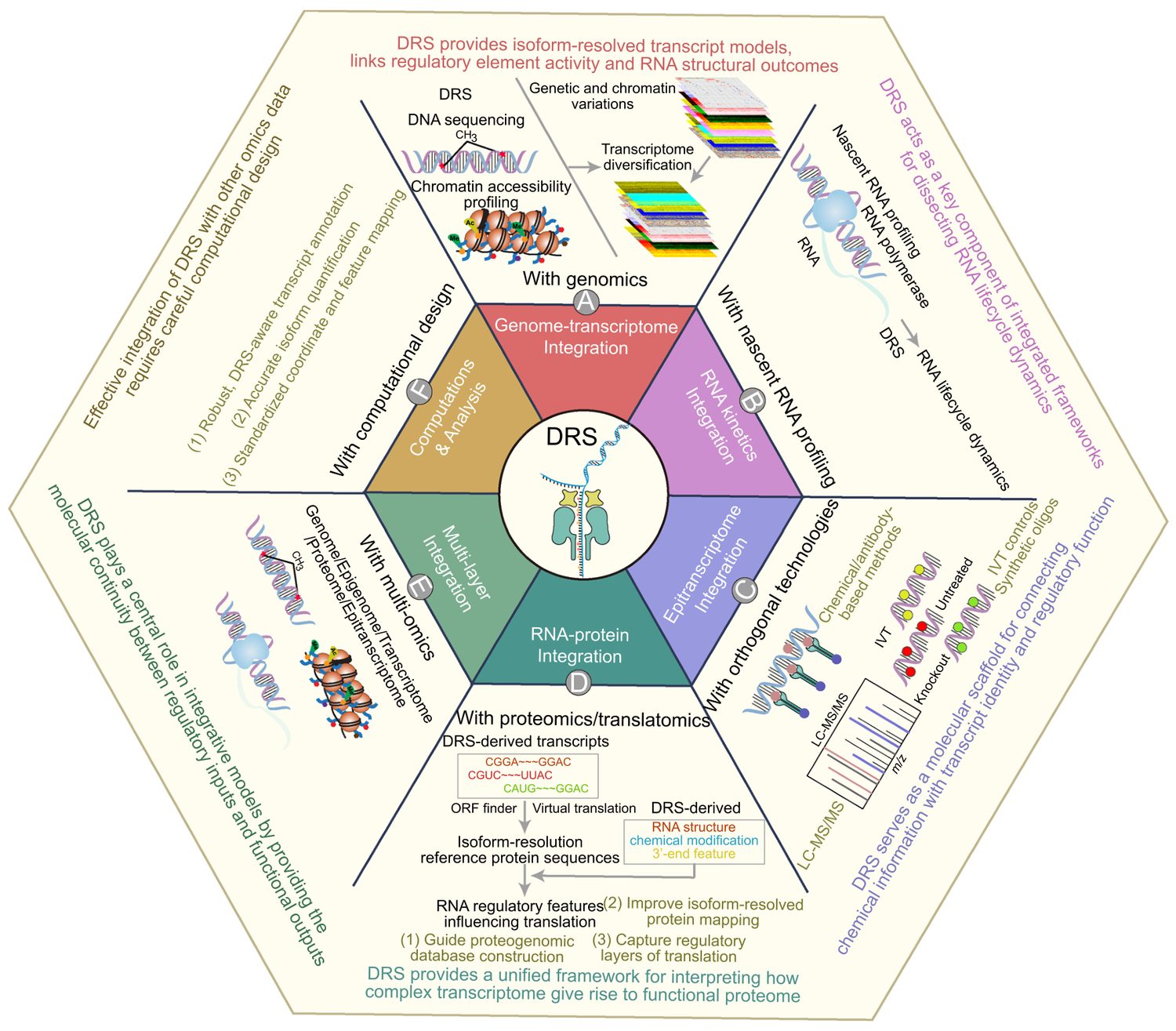
The deeper shift is in the unit of analysis. When sequence, structure, tail and modification come from one molecule, the question stops being how much a gene is expressed and becomes which transcript is present, and how it is decorated.
The review also sets a discipline: report direct signal and model inference separately, and give every modification claim an orthogonal check. A DRS budget should include an in vitro-transcribed negative control and a MeRIP-seq or LC-MS/MS comparison, not sequencing alone.
Related Sailgene Services
Sailgene's Direct RNA Sequencing service runs native RNA on PromethION without reverse transcription or PCR, reporting m6A, m5C, pseudouridine and inosine calls plus poly(A) tail length, with FASTQ and POD5 delivery. Where those calls need a trusted isoform, TSS and polyadenylation reference, Full-Length Transcriptome Sequencing supplies the annotation layer, and for species without a finished reference a Telomere-to-Telomere genome supplies the chromosome-scale coordinates that isoform annotation depends on.
The same direct-detection logic carries over to DNA: Nanopore DNA Methylation reads 5mC, 5hmC, 6mA and 4mC without bisulfite conversion, from POD5 data on the same platform family. Instrument and flow-cell options are listed on the PromethION platform page, and the sample requirements page collects the submission guidelines behind each library type.
Reference
- Zhang T, Li J, Tang C, et al. Nanopore direct RNA sequencing and the epitranscriptome: advances in mapping native RNA landscapes. iMeta. 2026;e70136. doi:10.1002/imt2.70136.
Contact Us
If you are interested in our long-read sequencing services or potential collaboration, please contact us. Our team is ready to support your research with tailored solutions. We also welcome feedback from users to help us improve our services.

Contact Us
Add: One Innovation Drive, Suite B3-406, Worcester, MA 01605, USA
在线客服添加返回顶部
右侧在线客服样式 1,2,3 1
图片alt标题设置: SAILGENE TECHNOLOGY INC.
表单验证提示文本: Content cannot be empty!
循环体没有内容时: Sorry,no matching items were found.
CSS / JS 文件放置地