Sailgene Technology

Full-Length Spatial Transcriptomics Resolves Isoform Diversity Across the Primate Brain
2026
Long-read Spatial Transcriptomics
Cynomolgus macaque (Macaca fascicularis)
Case Study
- Fullscope-seq pairs Stereo-seq spatial barcodes with long-read sequencing, reaching single-cell resolution and full-length isoform reads across a 5 × 3 cm tissue section.
- Spatial barcode recovery reached 89.7% (versus 56.8% for direct cDNA sequencing), and 6,434 novel isoforms were found in macaque brain.
- Isoform usage — not gene expression — separates cortical layers, cell types and brain regions, and maps onto autism, schizophrenia and bipolar disorder risk genes.
Research Background
The mammalian brain produces more RNA isoforms than any other tissue. Alternative splicing, alternative start sites and alternative polyadenylation let one gene yield several mRNAs, and disruption of this repertoire is linked to autism spectrum disorder (ASD), schizophrenia (SCZ) and bipolar disorder. Seeing it requires reading full-length transcripts inside intact tissue, cell by cell.
Spatial methods cannot do that yet: MERFISH and Xenium read only predefined probes, 10x Visium captures sequence at multi-cell spot resolution, and most platforms stop at sections under 1 cm² — too small for a primate brain. Fullscope-seq adds full-length long-read sequencing to large field-of-view Stereo-seq.
Experimental Design & Technical Strategy
The workflow keeps in situ capture and removes the two bottlenecks that made full-length spatial sequencing impractical:
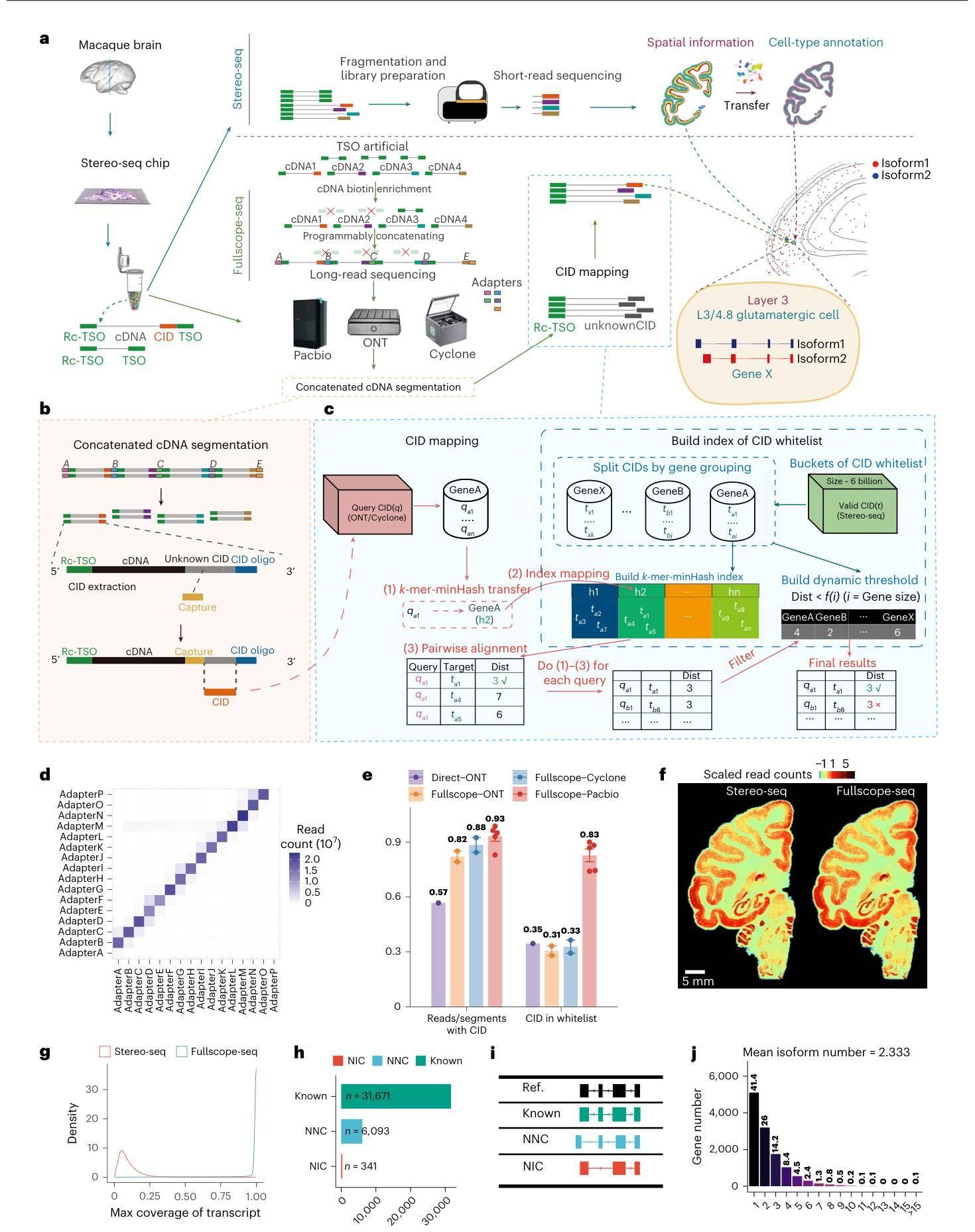
- Spatial capture: poly(A) RNAs are captured on a Stereo-seq chip and barcoded with roughly 6 billion coordinate identities (CIDs) at 500-nm resolution.
- Library: biotin capture enriches CID-bearing cDNA, removing the TSO-only artefacts that waste about half of conventional libraries; 15 adapters then join full-length cDNAs by programmable concatenation, suppressing length bias and meeting PacBio Revio read-length requirements.
- Sequencing: short reads give spatial mapping and cell annotation, while long reads on Nanopore (PromethION), PacBio and BGI Cyclone give isoform structure — 1,048 Gbp of long-read data for the main section versus 936 Gbp of short reads.
- Computation: concatemers are segmented into single cDNAs (97.0% valid full-length reads; about 80.0% mapping to the genome) and CIDs are assigned by a locality-sensitive-hashing algorithm.
Key Results
1. Most Reads Now Carry Both a Spatial Barcode and Full-Length Sequence
Biotin enrichment raised CID-containing reads to 89.7% from 56.8%, and read density matched Stereo-seq almost exactly (R = 0.998), so no spatial information was lost; whitelist mapping reached 82.8% on PacBio. Stereo-seq covered under 25% of most transcripts — too little to call isoforms — while Fullscope-seq covered most full-length transcripts and revealed 6,434 novel isoforms at 2.33 per gene. Against earlier Visium-based methods, that means about 1.2 million-fold more barcodes, 200-fold finer resolution (100 µm to 0.5 µm) and 35-fold more usable section area.
2. Cortical Layers Differ in Isoform Usage, Not Just Gene Expression
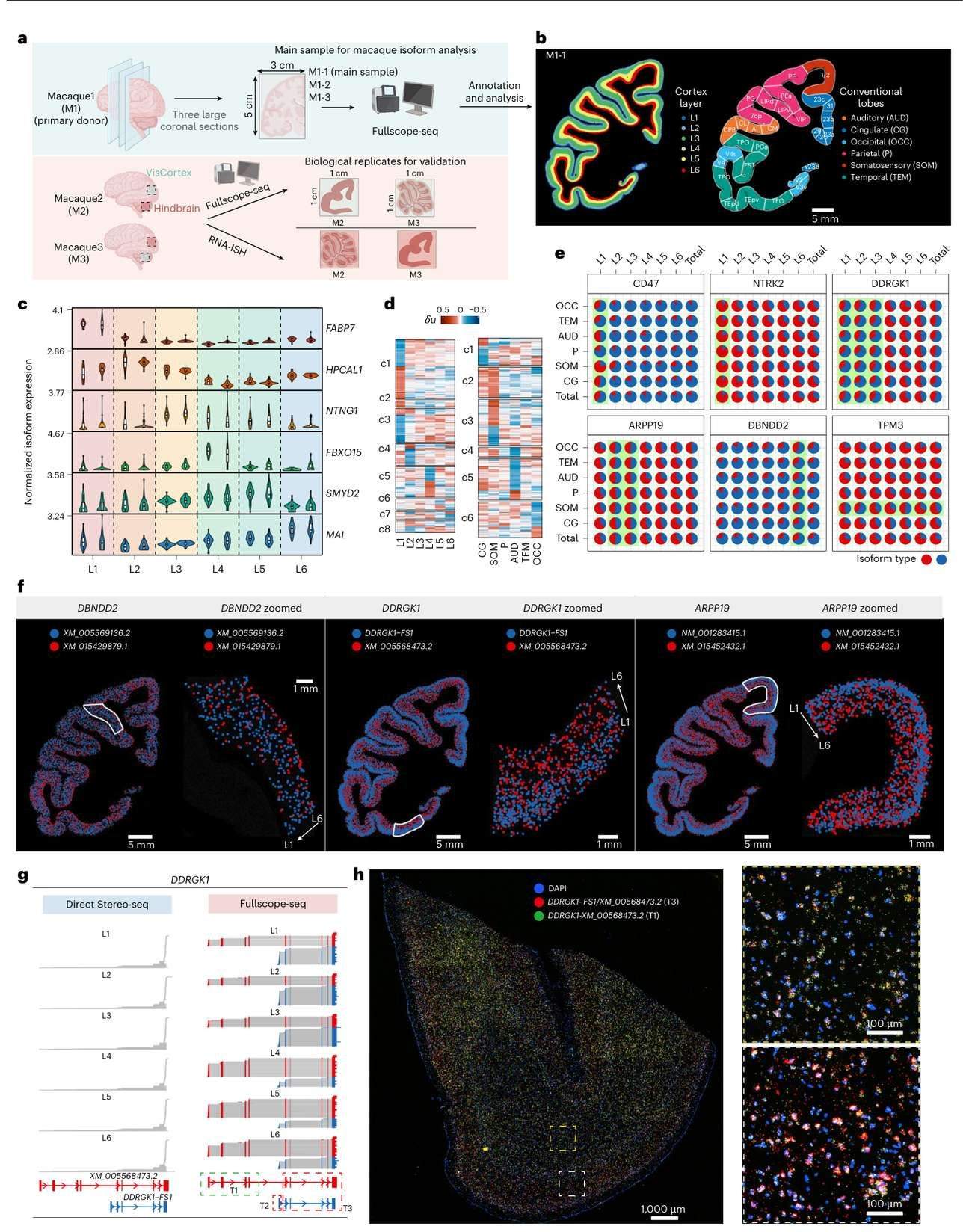
Isoform usage separated the six cortical layers: 981 differential transcript usage (DTU) isoforms from 576 genes across layers, 2,613 from 1,463 genes across 30 subregions and 627 from 358 genes across lobes, with 32 genes differing between superficial (L1–L3) and deep (L4–L6) layers. In DDRGK1, the novel isoform DDRGK1–FS1 uses a proximal start site and made up 63.0% of usage in superficial layers versus 39.7% in deep layers, truncating 1–170 N-terminal amino acids. Short-read data missed it entirely; RNA in situ hybridization confirmed it, and two further sections plus a second animal replicated it.
3. Cell Identity and Spatial Context Both Shape Splicing
388,443 cells resolved into 23 subclasses; 1,105 genes showed differential isoform usage across subclasses, and about 85% of them showed no differential gene expression at all. Glutamatergic cells carried the highest isoform diversity per gene (adjusted P = 1.1 × 10⁻⁶⁶), astrocytes the most DTU genes (389). Cell composition explained most layer effects (R = 0.561), while subregional variation split into 43.0% regional-only, 13.0% composition-only and 44.0% both — RTN1, for instance, shifts by subregion regardless of cell type.
4. One Section, Seven Brain Regions, and Disease-Relevant Isoform Switches
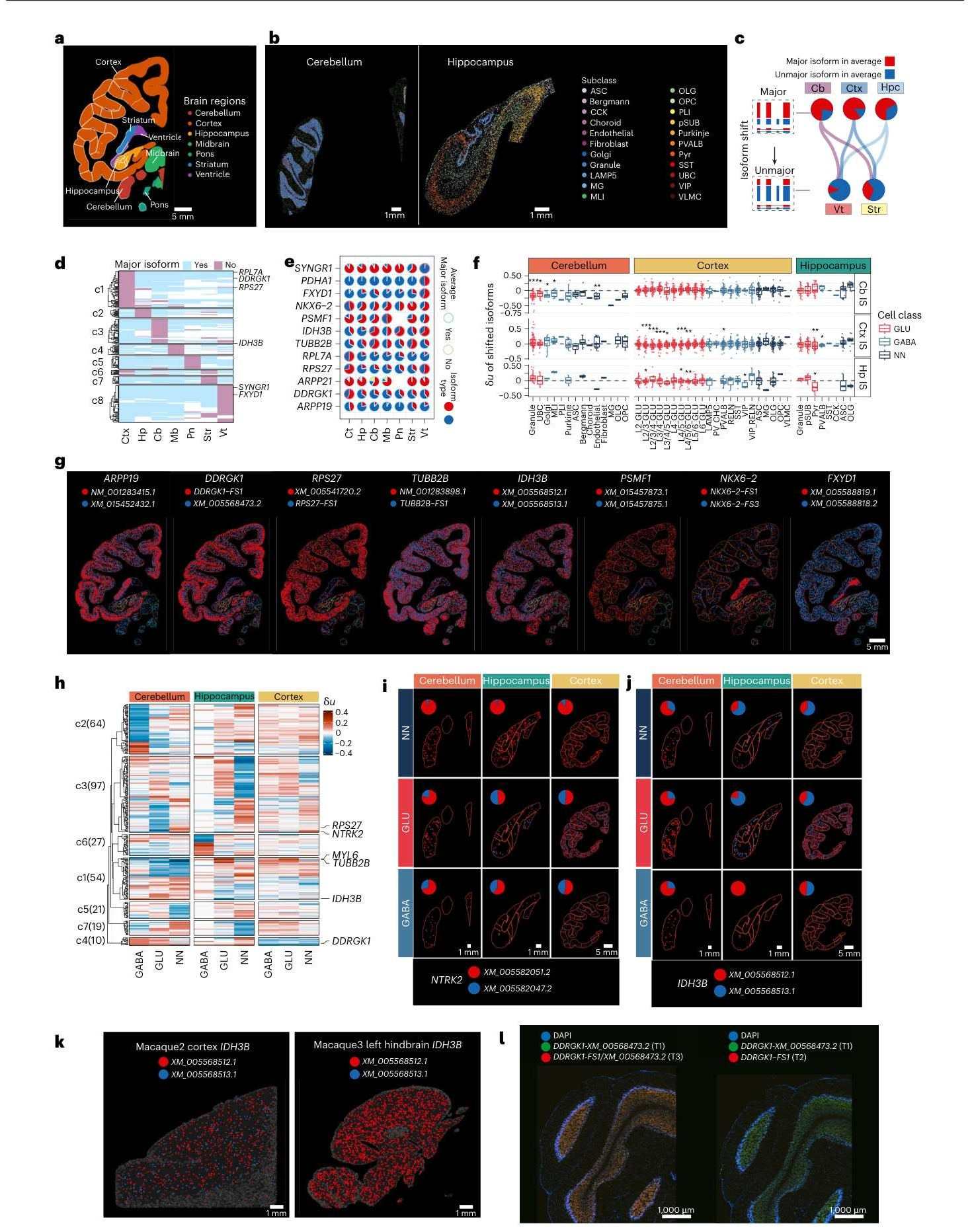
Within a single 5 × 3 cm section, seven brain regions could be compared: 1,445 genes showed DTUs and 375 (26.0%) underwent major isoform switching, with the cerebellum the most isoform-diverse region and the ventricle the least. GWAS gene sets for ASD, neurodevelopmental disorders, bipolar disorder, SCZ and epilepsies were consistently enriched among these genes, and 283 disease-associated isoforms from 265 genes had intron structures conserved between human and macaque — including CDC42, MYL6, NTRK2 and GRIN1.
Scientific Significance
Spatial transcriptomics has been stuck at gene-level counting because of library chemistry, not platform limits: once CID-bearing molecules are enriched and concatenated, standard long-read platforms read full-length transcripts straight from a spatial barcode, at single-cell resolution, across a field of view large enough for a primate hemisphere section.
Layer, subregion and cell identity each carry distinct isoform signatures that gene-level analysis cannot see, including a superficial-versus-deep shift in genes controlling neurite outgrowth. Because the strategy also works with other in situ capture chemistries such as Visium HD, it can move onto platforms many laboratories already run.
Related Sailgene Services
This work sits at the centre of Sailgene's Long-read Spatial Transcriptomics service, which pairs Stereo-seq or 10x Visium HD 3′ spatial capture with Nanopore long-read sequencing to deliver isoform quantification and alternative splicing calls with spatial coordinates. For dissociated samples, Long-read Single-Cell Transcriptome Sequencing resolves full-length isoforms per cell, while Full-Length Transcriptome Sequencing supplies the isoform, TSS and polyadenylation annotation that spatial isoform mapping depends on.
Reference
- Liu H, Hong Y, Zhang YS, et al. Full-length single-cell spatial transcriptomics reveals spatial and cell-type-specific transcript isoforms in the primate brain. Nature Methods. 2026. doi:10.1038/s41592-026-03174-y.
Contact Us
If you are interested in our long-read sequencing services or potential collaboration, please contact us. Our team is ready to support your research with tailored solutions. We also welcome feedback from users to help us improve our services.

Contact Us
Add: One Innovation Drive, Suite B3-406, Worcester, MA 01605, USA
在线客服添加返回顶部
右侧在线客服样式 1,2,3 1
图片alt标题设置: SAILGENE TECHNOLOGY INC.
表单验证提示文本: Content cannot be empty!
循环体没有内容时: Sorry,no matching items were found.
CSS / JS 文件放置地