Sailgene Technology

Complete Rhesus Macaque Genome Reveals Previously Unresolved Subtelomeric Regions
2026
Nanopore Ultra-long Sequencing (PromethION platform),Telomere-to-Telomere (T2T) Genome,Full-length Transcriptome Sequencing,HiFi Whole Genome Sequencing
Rhesus macaque (Macaca mulatta)
Case Study
Research Background
The rhesus macaque is an important model organism for biomedical and comparative genomic research. However, the previous reference genome, Mmul_10, contained unresolved or collapsed regions, particularly in highly repetitive and subtelomeric sequences.
These regions are difficult to assemble because repetitive sequences can be longer than conventional sequencing reads, making it challenging to determine their exact genomic structure.
This study aimed to construct a complete, high-accuracy rhesus macaque reference genome and investigate the biological features hidden within these previously unresolved regions.
Experimental Design & Technical Strategy
The researchers combined multiple sequencing technologies with complementary strengths:
- PacBio HiFi WGS: 178 Gb for high-accuracy genome assembly
- ONT ultra-long reads: 125 Gb, with reads ≥50 kb and an N50 of 109 kb, to resolve long and repetitive genomic structures
- Illumina WGS: 359 Gb for base-level validation and error correction
- PacBio Iso-Seq: full-length transcript sequencing to investigate transcriptional activity in newly resolved regions
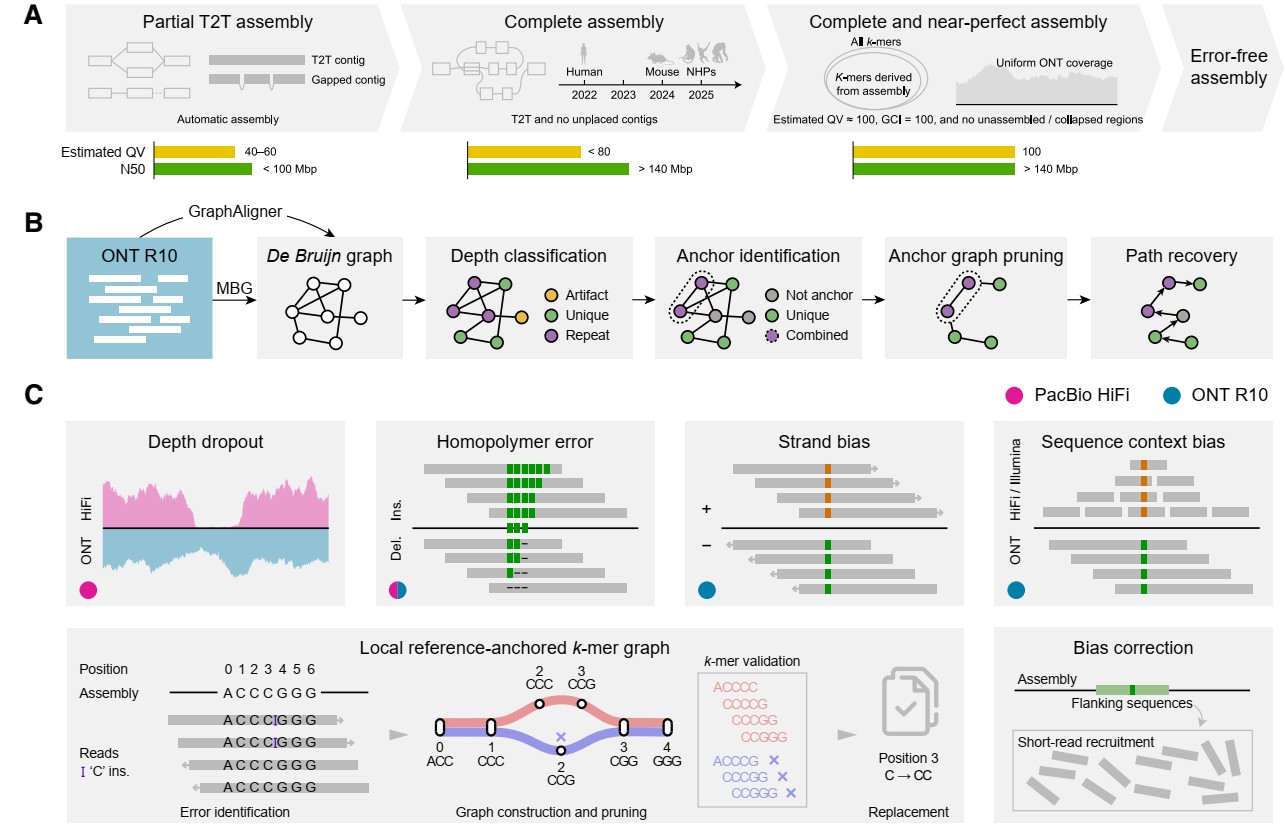
An initial genome assembly was generated using HiFi data. Regions showing abnormal coverage or potential assembly collapse were then investigated using ONT ultra-long reads.
The researchers developed an ONT-based assembly strategy to resolve complex repetitive regions and subsequently integrated HiFi and Illumina data for error correction and validation.
The final assembly was manually curated and evaluated using multiple genomic and transcriptomic datasets.
Key Results
1. A Near-Perfect T2T Reference Genome
The final assembly, T2T-MMU8v2.0, achieved:
- GCI = 100
- QV = 100
- No remaining assembly gaps
Approximately 302 Mb of sequence absent from the previous Mmul_10 reference was resolved.
2. Ultra-long Reads Resolved Complex Subtelomeric Regions
The researchers successfully assembled approximately 8 Mb of satellite-rich subtelomeric arrays (SATR).
They identified 268 previously uncharacterized repeat families and revealed four distinct subtelomeric genomic architectures.
These results demonstrate that highly repetitive subtelomeric regions can contain substantial genomic complexity that is not captured by conventional reference assemblies.
3. Previously Hidden Genes Were Revealed
The newly resolved regions contained duplicated gene copies that were absent or collapsed in the previous reference genome.
Importantly, 58 genes showed evidence of active transcription, supported by transcriptomic data.
PacBio Iso-Seq full-length reads provided direct evidence for transcription of several newly resolved gene copies, including ZNF669L and SH3TC1L.
4. The New Reference Improved Downstream Genomic Analysis
Compared with Mmul_10, the T2T reference improved read mapping and downstream analyses across multiple sequencing datasets.
The improved reference enhanced the detection and interpretation of:
- Structural variants
- Gene expression
- Chromatin accessibility
- Single-nucleus multi-omics signals
This demonstrates that improving genome completeness can directly improve downstream genomic analyses.
Scientific Significance
The study shows that difficult genomic regions are not simply technical “gaps.” Once resolved, they can reveal previously unknown repeat structures, duplicated genes, and transcriptionally active sequences.
The results also highlight the complementary roles of different sequencing technologies:
Ultra-long reads provide long-range information needed to resolve complex repeats, while HiFi reads provide high base-level accuracy. Illumina data support error validation, and full-length transcript sequencing helps determine the functional relevance of newly resolved genomic regions.
Overall, the study demonstrates how integrated long-read sequencing strategies can transform an incomplete reference genome into a more complete genomic resource and reveal biology that was previously inaccessible.
Related Sailgene Services
This study is particularly relevant to T2T Genome Sequencing, Ultra-long Read Sequencing, HiFi Whole Genome Sequencing, and Full-Length Transcriptome Sequencing.
Contact Us
If you are interested in our long-read sequencing services or potential collaboration, please contact us. Our team is ready to support your research with tailored solutions. We also welcome feedback from users to help us improve our services.

Contact Us
Add: One Innovation Drive, Suite B3-406, Worcester, MA 01605, USA
在线客服添加返回顶部
右侧在线客服样式 1,2,3 1
图片alt标题设置: SAILGENE TECHNOLOGY INC.
表单验证提示文本: Content cannot be empty!
循环体没有内容时: Sorry,no matching items were found.
CSS / JS 文件放置地